Sunday, 1 July 2012

Franz Crass, 1928-2012

The death was announced last Saturday of the great German bass Franz Crass. He had been bed-ridden since an accident last year and had been confined to a care home in Hochheim am Main since early last autumn. He had been forced to give up singing in 1981 because of hearing problems, but was a Bayreuth stalwart for many years, having first sung there in 1954 and given a breakthrough performance as the Dutchman in the 1960 season. Here's the monologue, from a 1961 performance, with Sawallisch conducting.


I'd been reacquainted with Crass's singing recently, too, when, in part inspired by the death of Dietrich Fischer-Dieskau, I'd finally bought Karl Böhm's classic Magic Flute. Fischer-Dieskau's Papageno and Fritz Wunderlich's Tamino are joined by some extravagantly-cast singers in secondary roles: having James King and Martti Talvela as the Armed Men is the male-cast equivalent to the Schwarzkopf-Ludwig-Höffgen trio of ladies in Klemperer's EMI set, on which Crass is also the Speaker. But in such exalted company Crass's Sarastro stands out for his nobility, solidity and beautiful smoothness. The rather brilliant Metropolitan Opera Guide to Recorded Opera puts it in straightforward terms: 'Franz Crass is as good a Sarastro as we have ever had on a complete set.' There's clearly not much more than can be said than that, for Alan Blyth is content to make more or less the same observation in his Opera on Record, writing that 'Franz Crass is arguably the best Sarastro on record: sonorous, easy of delivery, entirely credible'. 


In fact, the more I trawl through a gratifyingly large selection of clips on YouTube, the more it becomes clear that this was an artist who barely put a foot wrong, making a fantastic Commendatore (this clip, was clearly put together by a Ghiaurov fan, though)...


And, of course, a glorious Pogner. 


And, although I a quick bit of googling leaves me unsure whether he sang Sachs on stage, he certainly seems to have had what that role required, too. 


And here is something a bit rarer: Crass singing Verdi:


I've not noticed any obituaries yet in the UK press. I hope he gets at least one or two, because there can be little doubt of his position of one of the greatest basses of the second half of the 20th century. 

Wednesday, 20 June 2012

ENO: Billy Budd; Royal Opera: La Bohème

Apart from Doctor Dee, Monday evening's Billy Budd was the final new production of what's been, by any criteria, an impressive season for ENO. Apart from anything else, it's seen the newly-honoured Edward Gardner further galvanize the orchestra into a enormously impressive band, consistently delivering high-quality results across a wide repertoire. Few will be surprised that they played out of their collective skins in Britten's unflinchingly powerful score, or that the singing of the chorus pushed the Beaufort scale up to eleven, if you'll excuse the awkward collision of metaphor and allusion.

Kim Begley (above centre, as Vere), with Darren Jeffrey (l) and Jonathan Summers (r) (Photo: Henrietta Butler)
I doubt many were surprised by the generally fine home-grown cast, either, or the fact that, in David Alden's production, we only had hints of a ship. There was much yanking of ropes attached to something undefined off-stage, and, in Paul Steinberg's austere designs, vast panels vaguely suggesting of some sort of oversized vessel; but the crew, dressed in overalls, seemed to be part of some large industrial machine. With officers in leather greatcoats, as well as plenty of guns and truncheons, the atmosphere was one of generalized oppression. For me prisoners of war came to mind, but the references achieved an admirable sense of universality: difficult to pin down, perhaps, but, at the same time, not worryingly specific. It was all impressive in its way, but there seemed to be a discrepancy between some highly-stylized movement (the guards were a case in point, while the dancing accompanying the sea shanty turned more Billy Elliot than Budd) and the naturalism elsewhere, and I couldn't escape the feeling that, having decided to avoid anything so obvious as a recognizable ship, Alden hadn't exactly worked out what he was replacing it with. The juxtaposition achieved between the bowels of whatever we were in and all-in-white Starry Vere's cabin--looking for all the world like a sterilised capsule tucked surreptitiously half way around the Large Hadron Collider--couldn't have been clearer, I suppose, but the whole thing was nevertheless a bit vague.

Matthew Rose as Claggart (photo: Henrietta Butler)
Or at least it definitely would have seemed so, had we not had some impressive, sharply directed central performances. As Vere, Kim Begley had stepped in to replace Toby Spence, and did an excellent job, communicating nobility and anguish and singing with impressive security. The young and young-sounding Spence would have been unusual casting, but would have been interesting against Matthew Rose's unusually youthful Claggart. And, as with so often with the baddies, it was Rose (the recent well-deserved recipient of the Critics Circle Exceptional Young Talent Award) who stole the show. His bass voice is not the gnarly beast often heard in the role, but its cultivated beauty, if anything, made him all the more chilling in the part (as it had in his recent Sparafucile at the Royal Opera), while Adam Silverman's lighting brought a sepulchral evil to his clean-shaven face. His Iago-like credo below decks was chilling in the extreme; the subsequent total subjugation of Nicky Spence's excellent Novice deeply disturbing.

The one main gripe about the casting must involve Benedict Nelson's Budd. There's no doubting he's an outstanding talent, and the voice itself can be very beautiful indeed. But it only seems to be so within limits, with notes at the top, in particular, coming across as noticeably manufactured--especially so in the otherwise excellent scene before his execution. But, more seriously, it's a voice that lacks the volume and bite to carry this show, often getting swallowed up. I wondered, too, if a certain exaggeration in his physical performance was designed to compensate. Otherwise the cast, a compendium of British vocal talent (the ever-green Gwynne Howell still going strong as a touching Dansker at one end of the wide age spectrum), has no weakness. And, while I'm not sure this is quite the knockout show it should be, it's certainly got plenty to make it worth seeing.


Finally, here's a quick word about yesterday evening's La Bohème at the Royal Opera House. I'm writing it up for OPERA so can't give away much about the show itself, which was the first of two to reunite Roberto Alagna and Angela Gheorghiu as the ill-fated poet and manually-challenged seamstress. But there was some unexpected drama when, after two attempts, the house curtains remained stubbornly closed. Twice an unsurprisingly sheepish member of the technical team came out to apologise, then after a quarter of an hour, in a master stroke of positive spin, it was announced the curtains would be removed, and we'd witness open scene changes, a treat usually reserved for school children. John Copley's famously lavish and realistic production, we were additionally told, was about the best staging to see being openly changed. Repeated attempts to raise the burgundy-velvet beasts were met with 'ooohs' and 'aaahs', as if Rooney had just narrowly missed a free-kick. 


When finally we got under way (about 30 minutes behind schedule), the largely jolly audience cheered as if he'd finally scored. And, as promised, it was indeed engrossing to see the first scene change in all its glory. The garret was whisked away to reveal Cafe Momus, slightly squished together with all its lavishly-dressed chorus and extras secreted behind, before the whole lot slid silently towards us. After being opened out a bit and given a few extra tweaks, we got going again. (It made me wonder why we don't see more productions with fluid, 'open' scene changes at the Royal Opera--there's not much in theatre that's more seductive). Things seemed relatively back-to-normal after the interval, but no risks were taken: there was a black out at the end, ahead of the curtains being gently closed. At this star-driven show, though, it was nice to be reminded of the immense amount of backstage work involved to bring things together. But, since the performance was given to mark the famous couple's 20 years at the Royal Opera, here's a little bit of them. 


Friday, 15 June 2012

Pires, LSO/Haitink: Purcell, Mozart, Schubert; Purcell, Mozart, Bruckner

There wasn't much to grab the headlines at these two fine London Symphony Orchestra concerts, one on Sunday and one on Thursday, but a lot to remind one of how a solid, conventional programme can still prove a highly rewarding experience. At least it certainly can with a soloist like Maria João Pires and a conductor like Bernard Haitink, in charge of an alert LSO. Each concert started with an arrangement of Purcell. The D-minor Chacony came first, performed with restraint and discipline by a beefy complement of strings; it was Britten's faithful arrangement, I gather, even though the fact was not acknowledged in the running order. Thursday brought Steven Stucky's 1992 take on the famous Funeral Music for Queen Mary, interestingly refashioned for brass and percussion (including piano and harp). It amplified the work into something effective and visceral--the thudding piano-and-timpani pedal point was a stroke of inspiration--but I was less convinced as it veered off into altogether unexpected territory in the central section.

Pires brought irresistible lightness and instinctive, unforced musical imagination to her two Mozart concertos--the D minor K.466 in the first concert, the A major K.488 in the second--with Haitink providing excellent support, and the LSO winds, especially, on wonderful form. There was controlled drama in the D minor work, too, with the diminutive pianist showing that she can pack a punch, particularly in a beautifully gauged account of Beethoven's cadenza (and here, just for fun, is a great clip of her being surprised in a concert, for one reason or another expecting a different concerto and having to pull up K.466 from the memory bank--'sprong zi in paniek op' indeed). 


The Romanze was delicately done, with some floated, long phrases, too. The same virtues distinguished the A major work, where, if anything, Pires's playing was even more delicate. Her understated interpolations in the barer passages of the Adagio were self-effacing almost to the point of inaudibility--those in favour of such additions would have been kept happy; those not wouldn't have had to much difficulty in filtering them out. But was I alone in wishing she'd assert herself a bit more in the presto finale, where much of the filigree in the piano part was lost?

When it comes to large-scale Austro-German symphonies, Haitink is never anything less than a reliable guide. Here he was a great deal more than that. His Schubert Ninth (on Sunday) might have been a bit hard pressed in the opening movement, but the single-mindedness of his approach brought powerful results in the remarkable Andante, and, with the LSO playing with considerable virtuosity, the Scherzo and Finale ticked along in the pleasing way only this music can--all airy inevitability and breeziness. Bruckner's symphonies are the natural heir to Schubert's 'Great' in particular, adding considerable weight to that work's 'heavenly length'. Haitink's Bruckner is justly famous--even if his Concertgebouw Fifth recently at the Barbican apparently bowled some over and left others cold--and this Seventh was a fine piece of work. Beautifully paced, and with a sobriety to contrast with the fire of Daniel Barenboim's recent RFH account, it nevertheless suffered from the Barbican's cramped acoustic, which made this music teeter over in the climaxes from assertive to aggressive (although I'm perhaps being generous to the players here: I notice a colleague shifts some blame on to them in his review). This did Bruckner's music, redolent of Alpine air and the sort of wholesomeness that was not without some more unpleasant ideological resonances in the 20th century, few favours. With the Vienna Phil, in the, ahem, rather less bright acoustic of the Albert Hall, the conductor's Bruckner 9 at the Proms is certainly something to look forward to.


Tuesday, 12 June 2012

Cape Town Opera: Porgy and Bess

Here's a link to my review of Cape Town Opera's Porgy and Bess, which I caught at the Birmingham Hippodrome on the first leg of a six-week tour. Cardiff will also get to see The Mandela Trilogy, a new trio of work's celebrating the Great Man's life. The company, which was formed just 13 years ago to tie together various threads of existing institutions (the Cape has a long operatic history: Der Freischütz had made it there in 1831, for example, we read in the programme), oozes with talent, and the choral singing--reflecting a strong local tradition--is astonishingly focussed and powerful. And, given the restrictions no doubt imposed by the touring schedule, the staging is eminently decent. As I hint in my review, though, the work itself has its issues: in terms of racial politics, of course, it opens up a can of worms--and this can is shaken about further by this show, which shifts the action to a Soweto township in the 1970s. It's great entertainment, of that there's no doubt, but should it be?

Details of the tour can be found at http://www.porgyandbess2012.co.uk/, and those in London will have a good chance to catch the show during its ten-day sting at the Coliseum

Tuesday, 29 May 2012

Deborah Warner's Vienna Traviata

In haste, here's a link to my review of Deborah Warner's new Traviata in Vienna. It's smartly updated, looks great, and with a cast and conductor hovering around and about the 30-year mark, made me feel rather old. As I explain in the review, though, there's a danger in updating a work that -- for better or worse -- is so deeply entrenched in 19th-century values; and I'm not sure Warner really finds a solution to the problems that are thrown up. Here's a little video, anyway, focussing on the production's Alfredo, to give a taster.


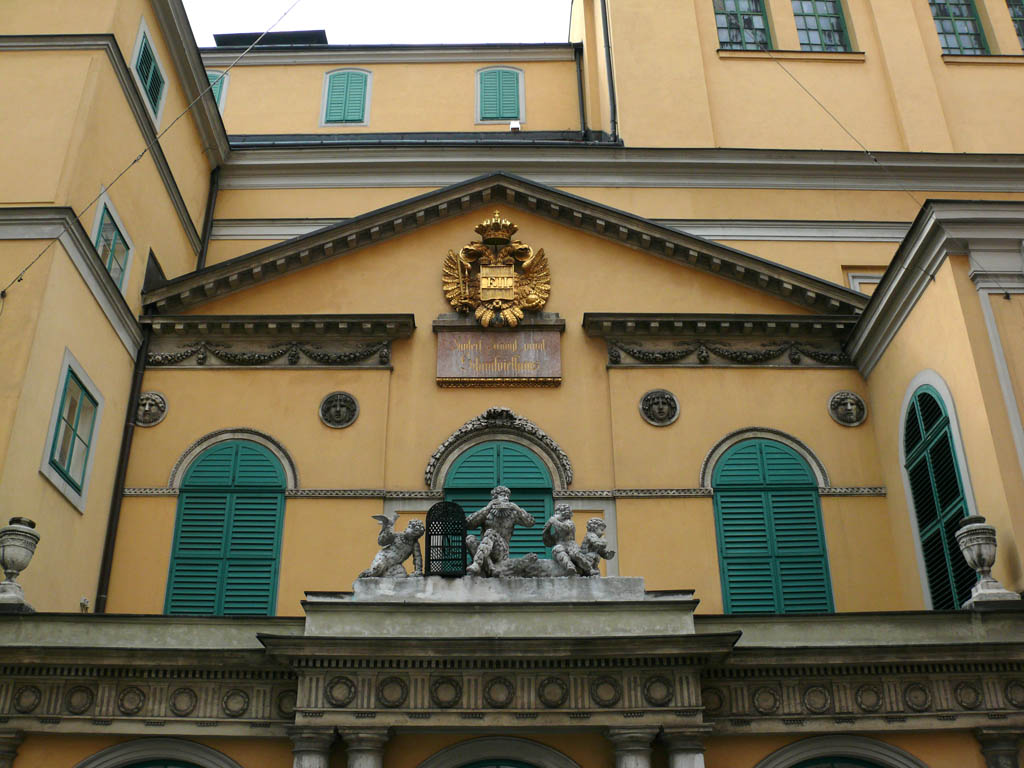
It's certainly great to see the Theater an der Wien, so long, like many of London's great theatres, clogged up with entertainments of a less lofty sort, staging a small but eminently interesting opera season, and breathing down the neck of the Staatsoper down the road. Arguably, though, Cats, which ran there for many years, is not a million miles away from the sort of popular entertainment of which Emanuel Schikaneder was such a prolific peddlar -- the theatre's founder is commemorated here on the famous Papagenotor, tucked inconspicuously down a side road.


And here's the lavish interior of the intimate auditorium, which one hardly expects when entering through the modern foyer opposite the Naschmarkt.


Monday, 28 May 2012

Caligula and Madam Butterfly at ENO


I’d been greatly looking forward to seeing Detlev Glanert’s Caligula at ENO. I’d got to know the work a little, along with Rihm’s Jakob Lenz, when writing a feature about both of them, concluding that they were both admirable pieces that made no apologies for their status as opera and suggesting that Caligula might join Lenz as one of only a small number of new operas to cement their position in the repertoire (although, admittedly, Lenz is as old as I am, and has the advantage of requiring ‘only’ chamber forces). In the event, I was left somewhat disappointed by ENO’s performance of the Rihm in the Hampstead Theatre (my review’s here), feeling that Sam Brown’s production didn’t exactly help focus the mind, with its insistence on so much painstaking period realism. 

Peter Coleman Wright as Caligula (c) Johan Persson
Similarly, I didn’t feel at Friday evening's UK premiere of Glanert's work that Caligula was helped a great deal by Benedict Andrews’s production, where the whole action takes place in a sports stadium, with a steeply tiered grandstand (designed by Ralph Myers) rising up from the front of the stage. There’s a tunnel through which the characters enter and exit, while some often come in from the back down the central aisle, too. In his programme note, Andrews argues sensibly for this configuration, and it’s not unknown, of course, for the sports stadium to become a crucible for rather ugly expressions of statehood, quite aside from the more specific historical examples Andrews cites where they have been co-opted by fascist regimes (and, coincidentally, this week’s Panorama deals with the odious political extremism that apparently still blights football in the Euro 2012 host nations, Poland and Ukraine). He also argues convincingly that it chimes with Caligula’s apparent interest in the aesthetic representation of power, the theatricality of the torture and humiliation he inflicts on those around him.

Peter Coleman Wright as Caligula (c) Johann Persson
I couldn’t help wondering, however, whether this staging, with its unflinching emphasis on the horror of Caligula’s reign of terror – sparked off by the death of his sister and lover, Drusilla – missed some of the work’s subtlety. Drusilla was here portrayed, like the Friederike Brion added to Jakob Lenz, by a mute actress; unlike her counterpart in Lenz, though, she (played by Zoe Hunn) wanders about naked and half-dead. The palace of the original setting suggests all sorts of moments of intimate confession, as well as eavesdropping that Andrews’s production struggles to evoke. The bizarre extras dotted about – a pair of prostitutes in gold wigs, people dressed in animal masks, redneck sports fans – seem to underline Caligula’s madness as less driven by logic than Camus’s original play suggests. 

Camus wrote that his play portrayed the real horror of fascism being the result of logic being pursued and pushed to an extreme degree, but the line between calculated, logical horror and straightforward common-or-garden lunacy seems rather too blurred here. Nevertheless, Peter Coleman-Wright is enormously impressive as Caligula himself, providing a performance that is hardly less compelling, dramatically speaking, than Andrew Shore’s as Lenz. I only wished, however, for more vocal authority, for the ability to hold forth and decree with greater force and volume. This is a role which would surely benefit from a bit of suavity, too; as I let my mind wander, I idly speculated as to whether someone like Simon Keenlyside could made available for the revival (if there is one).

The other outstanding performance came from the countertenor Christopher Ainslie as Caligula’s preening, sycophantic and duplicitous slave, Helicon. There was also excellent work from Yvonne Howard as Caligula’s wife, Caesonia, and Carolyn Dobbin as Scipio, both able to enjoy moments of quasi-lyrical respite and intimacy with the emperor, where Glanert’s unflinching scoring melts into something more seductive. As a whole, though, despite some outstanding playing from the ENO orchestra under Ryan Wigglesworth, the music came across as less focussed and communicative here than it had struck me when listening to the Oehms Classics set (recorded at the work’s 2006 premiere in Frankfurt) with which I’d go to know it. It’s undeniably fluent, but doesn’t lead one to care a great deal about Caligula himself, which is perhaps surprising, since, as Glanert himself has explained, it can be understood as emanating from him, reflecting his own subjective take on events. If the production had been similarly unflinching in its focus on him, maybe the effect would have been a great deal more powerful.

Photo (c) Clive Barda
It seems a bit of a jump to Puccini’s Madam Butterfly, especially since the opera’s protagonist is denied much influence on her surroundings: Puccini’s very much in control of her destiny and our reaction to it, and the work has often – and often rightly – been criticized as coldly manipulative as a result. And, needless to say, few operatic women are left more undone than ‘povero Butterfly’. When it’s well done, however, there’s only so long that one can keep dousing the emotional fire with such criticisms. 

Such was the case when I finally got around to seeing the late Anthony Minghella’s famous 2005 production for ENO on Saturday (revived here by Sarah Tipple, whose previous credit somewhat incongruously includes the West End’s Dirty Dancing). And I was pleased, too, to catch Oleg Caetani’s sure footed, beautifully gauged account of the score, with the orchestra oozing once again the sort of quality that only a few years ago was pretty rare in the Coliseum. And the production itself is gorgeous, a visual feast that wafts fragrantly from the realistic to the dreamily evocative. I seem to remember the Banraku puppetry used for Butterfly’s son dividing opinion when the production was new, but I found it properly enchanting: the fixed, wide-eyed innocence of this puppet, manoeuvred with brilliant dexterity, seemed more childlike than much of what we see from children on operatic stages.

The cast is a good one, too, and I particularly enjoyed the easy security of Gwyn Hughes Jones’s Pinkerton – subjected to a bit of pantomime-villain booing at the curtain. Mary Plazas turns in a powerful, moving Butterfly, and John Fanning is excellent as a dapper Sharpless. All ENO's revivals are designated 'classic' these days, but this one deserves the epithet. 

Tuesday, 22 May 2012

WNO Tristan; Volodos at the RFH

Here's a link to my review of Welsh National Opera's largely excellent Tristan revival, which opened on Saturday (and if any, like the commenter on the piece, find it difficult to infer who was conducting, it was Lothar Koenigs). Ann Petersen has recently performed Isolde with Marek Janowski and the Berlin Radio Symphony Orchestra, the recording of which promises to be something quite special -- particularly since what I've heard of  Janowski's swift Parsifal so far is so promising (the review's forthcoming in OPERA). In the meantime, this little clip of Marietta's Lied gives an idea of how unusually lyrical an Isolde Petersen made.


Coming back to London, I was very much looking forward to Arcadi Volodos's Royal Festival Hall recital this evening. The programme -- Schubert's remarkable D.784 Sonata, Brahms's Op. 117 Intermezzi and Liszt's B-minor Sonata -- was intriguing, if a little diffuse in focus. And I'd been enormously impressed with Volodos's performance of the Liszt in Dresden just over a year ago. However, while the work on that occasion seemed to be driven forward by an inexorable force that seemed to impose on it some irresistible logic, here Volodos seemed interpretatively at sea. 

The technique, unsurprisingly, was dazzling and the apparent ease with which he negotiated the work's technical challenges was often breathtaking. However, such facility seemed to bring with it interpretative issues. I've made a similar point when referring to his Brahms second Piano Concerto earlier in the year, wondering whether or not technical hurdles necessitate certain interpretative choices when effort is required to negotiate them; here, certainly, there was a sense that the facility had left something of a void which Volodos struggled to fill . Bass octaves, therefore, thundered arbitrarily away, passage work was dispatched with special twinkly brilliance in a beguiling pianissimo, voicing was exquisitely measured; but none of it communicated any greater purpose to me. Perhaps most telling was the unnatural and unconvincing rubato that marred the sonata's more improvisatory passages. Dazzling? yes, in its way. Compelling? no. 

The Schubert and Brahms in the first half were more effective, but for all their considerable beauties -- and Volodos can coax sounds out of a Steinway that few can match for sheer melting beauty -- still rather blank interpretatively speaking. And here the programming didn't help, either, for these two works added up to rather a lot of dreamy romanticism, or at least did so in Volodos's interpretations.

Despite some pretty shabby behaviour from the audience -- an alarm going off half way through the Liszt, someone yelling a 'bravo' at the close before Volodos had relaxed and raised his hands from the keyboard -- the pianist provided a generous clutch of encores, finishing with the same strange, wonderful Schubert Minuet D. 600 he'd played after the Brahms concerto. It was preceded by the shameless showiness of his own transcription of Ernesto Lecuona's 'Malegueña', as below.

I remember when Volodos first arrived on the scene with his stunning disc of virtuoso transcriptions -- his version of the Mozart's Rondo 'alla turca' seemed to revive the much-maligned genre. Then, there was a certain doubt as to the depth of his musicianship beneath the spectacular surface. Now, with this recital some 15 years later, that spectacular surface once again obscured what might -- and, I believe, does -- lie below.